The Ruins of Machu Picchu

The best places for you. See and visit ........

Port town, Oban

The best places for you. See and visit ........

Tuscany, Countryside with Beautiful Landscapes

The best places for you. See and visit ........

Raja Ampat

The best places for you. See and visit ........

Aomori City

The best places for you. See and visit ........

Showing posts with label ethnic. Show all posts

30.7.11

Minangkabau, the World's Largest Matrilineal Society

minangkabau
The Minangkabau ethnic group (also known as Minang) is indigenous to the highlands of West Sumatra, in Indonesia. The Minangkabau are strongly Islamic, but also follow their ethnic traditions, or adat. The Minangkabau adat was derived from animist beliefs before the arrival of Islam, and remnants of animist beliefs still exist even among some practicing Muslims. The present relationship between Islam and adat is described in the saying "tradition [adat] founded upon Islamic law, Islamic law founded upon the Qur'an" (adat basandi syara', syara' basandi Kitabullah). 


The Minangs are the world's largest matrilineal society, in which properties such as land and houses are inherited through female lineage. Some scholars argue that this might have caused the diaspora (Minangkabau, "merantau") of Minangkabau males throughout the Maritime Southeast Asia to become scholars or to seek fortune as merchants. As early as the age of 7, boys traditionally leave their homes and live in a surau (a prayer house & community centre) to learn religious and cultural (adat) teachings. This tradition has created Minang communities in many Indonesian cities and towns, which nevertheless are still tied closely to their homeland; a state in Malaysia named Negeri Sembilan is heavily influenced by Minang culture.
The first female minister was a Minang scholar.


In addition to being renowned as merchants, the Minangs have also produced some of Indonesia's most influential poets, writers, statesmen, scholars, and religious scholars. Today both natural and cultural tourism have become considerable economic activities in West Sumatra.


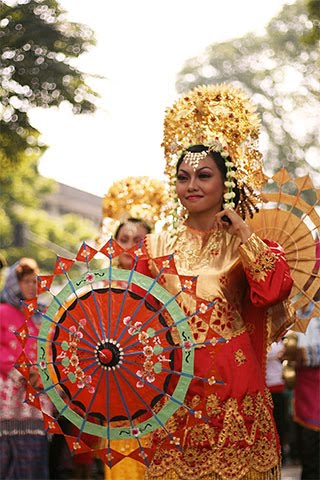
Traditional Minangkabau music includes saluang jo dendang which consists of singing to the accompaniment of a saluang bamboo flute, and talempong gong-chime music. Dances include the tari piring (plate dance), tari payung (umbrella dance) and tari indang. Demonstrations of the silat martial art are performed. Pidato adat are ceremonial orations performed at formal occasions.


Saluang

Randai is a folk theater tradition which incorporates music, singing, dance, drama and the silat martial art. Randai is usually performed for traditional ceremonies and festivals, and complex stories may span a number of nights. Randai performances are a synthesis of alternating martial arts dances, songs, and acted scenes. 


Rumah gadang ('big house') - or more correctly rumah bagonjong - are the traditional homes (Indonesian: rumah adat) of the Minangkabau. The architecture, construction, internal and external decoration, and the functions of the house reflect the culture and values of the Minangkabau. A rumah gadang serves as a residence, a hall for family meetings, and for ceremonial activities. With the Minangkabau society being matrilineal, the rumah gadang is owned by the women of the family who live there - ownership is passed from mother to daughter.
Rumah Gadang

The houses have dramatic curved roof structure with multi-tiered, upswept gables. Shuttered windows are built into walls incised with profuse painted floral carvings. The term rumah gadang usually refers to the larger communal homes, however, smaller single residences share many of its architectural elements.


Animism has been an important component of Minangkabau culture. Even after the penetration of Islam into Minangkabau society in the 16th century, animistic beliefs were not extinguished. In this belief system, people were said to have two souls, a real soul and a soul which can disappear called the semangat. All Minangkabau customs allegedly in conflict with the Koran were to be abolished. Although the Padri were eventually defeated by the Dutch, during this period the relationship between adat and religion was reformulated. Previously adat was said to be based upon appropriateness and propriety, but this was changed so adat was more strongly based upon Islamic precepts.

The Minang's adat and their Islam religion each help the other and thus form "a hedge against the decline of either", as follows: "The passion the Minangkabau pour into religion and adat " on the one hand strengthens adat which then limits "the destructive consequences of Western capitalism" and on the other hand guards their religion "against falling lockstep into a simplistic anti-Western Islamism."
With the Minangkabau highlands being the heartland of their culture, and with Islam likely entering the region from coast it is said that ‘custom descended, religion ascended’ (adat manurun, syarak mandaki).


Randai


Tari Payuang (Umbrella Dance)
Rumah Gadang

26.7.11

Dayak, the Native People of Borneo

Traditionally, Dayak agriculture was based on swidden rice cultivation. Agricultural Land in this sense was used and defined primarily in terms of hill rice farming, ladang (garden), and hutan (forest). Dayaks organised their labour in terms of traditionally based land holding groups which determined who owned rights to land and how it was to be used. The main dependence on subsistence and mid-scale agriculture by the Dayak has made this group active in this industry. The modern day rise in large scale monocrop plantations such as palm oil and bananas, proposed for vast swathes of Dayak land held under customary rights, titles and claims in Indonesia, threaten the local political landscape in various regions in Borneo.

Further problems continue to arise in part due to the shaping of the modern Malaysian and Indonesian nation-states on post-colonial political systems and laws on land tenure. The conflict between the state and the Dayak natives on land laws and native customary rights will continue as long as the colonial model on land tenure is used against local customary law. Underlying the world-view is an account of the creation and re-creation of this middle-earth where the Dayak dwell, arising out of a cosmic battle in the beginning of time between a primal couple, a male and female bird/dragon (serpent). Representations of this primal couple are amongst the most pervasivel motifs of Dayak art. The primal mythic conflict ended in a mutual, procreative murder, from the body parts of which the present universe arose stage by stage. The practice of Kaharingan differs from group to group, but shamans, specialists in ecstatic flight to other spheres, are central to Dayak religion, and serve to bring together the various realms of Heaven (Upper-world) and earth, and even Under-world, for example healing the sick by retrieving their souls which are journeying on their way to the Upper-world land of the dead, accompanying and protecting the soul of a dead person on the way to their proper place in the Upper-world, presiding over annual renewal and agricultural regeneration festivals, etc.Religious differences between Muslim and Christian natives of Borneo has led, at various times, to communal tensions.Muslim Dayaks have however retained their original identity and kept various customary practices consistent with their religion.


An example of common identity, over and above religious belief, is the Melanau group. A few practise a distinct Dayak form of Kaharingan, known as Liko. Liko is the earliest surviving form of religious belief for the Melanau, predating the arrival of Islam and Christianity to Sarawak. Social cohesion amongst the Melanau, despite religious differences, is markedly tight.


Despite the destruction of pagan religions in Europe by Christians, most of the people who try to conserve the Dayak's religion are missionaries. For example Reverend William Howell who has contributed to the Sarawak National Gazette. His contributions were also compiled in the book The Sea Dayaks and Other Races of Sarawak.


Kinship in Dayak society is traced in both lines. Although, in Dayak Iban society, men and women possess equal rights in status and property ownership, political office has strictly been the occupation of the traditional Iban Patriarch. The most salient feature of Dayak social organisation is the practice of Longhouse domicile. The Iban of the Kapuas and Sarawak have organized their Longhouse settlements in response to their migratory patterns. Iban Longhouses vary in size, from those slightly over 100 metres in length to large settlements over 500 metres in length. Longhouses have a door and apartment for every family living in the longhouse. Dayak headhunters

Headhunting was an important part of Dayak culture, in particular to the Iban and Kenyah. External interference by the reign of the Brooke Rajahs in Sarawak and the Dutch in Kalimantan Borneo curtailed and limited this tradition. Apart from massed raids, the practice of headhunting was then limited to individual retaliation attacks or the result of chance encounters. Early Brooke Government reports describe Dayak Iban and Kenyah War parties with captured enemy heads. At various times, there have been massive coordinated raids in the interior, and throughout coastal Borneo, directed by the Raj during Brooke's reign in Sarawak. Metal-working is elaborately developed in making mandaus (machetes - 'parang' in Indonesian ).


The combination of these three factors (short, cutting edge up and protrusion) makes for an extremely fast drawing-action. There are various terms to describe different types of Dayak blades.

Dayaks in Indonesia and Malaysia have figured prominently in the politics of these countries. Organised Dayak political representation in the Indonesian State first appeared during the Dutch Administration, in the form of the Dayak Unity Party (Parti Persatuan Dayak) in the 30s and 40s. Feudal Sultanates of Kutai, Banjar and Pontianak figured prominently prior to the rise of the Dutch Colonial rule.


Political circumstances aside, the Dayaks in the Indonesian side actively organised under various associations beginning with the Sarekat Dayak established in 1919, to the Parti Dayak in the 40s, and to the present day, where Dayaks occupy key positions in government.


In Sarawak, Dayak political activism had its roots in the SNAP (Sarawak National Party) and Pesaka during post independence construction in the 1960s. Under Indonesia's transmigration programme, settlers from densely-populated Java and Madura were encouraged to settle in the Indonesian provinces of Borneo. In 2001 the Indonesian government ended the gradual Javanese settlement of Indonesian Borneo that began under Dutch rule in 1905.